Photography
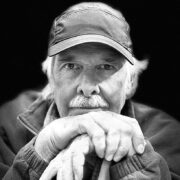
Photography has been part of James Arthur Curtis’ life since he was a teenager in Saratoga, California. A resident of Oregon since 1982, Curtis continues to explore ideas through nature-based subjects. He attended Southern Oregon College in Ashland, and later graduated from CSUF. For thirty-six years he owned and operated On The Wall, Incorporated, a picture framing business in Medford, Oregon with his wife who, for ten years, operated an exhibition gallery.
Initially influenced by subjective photography and the works of Minor White and Brett Weston, Curtis explored basalt canyons of the Rogue River, Death Valley’s Zabriski Point, and the granite rock formations of the Sierra Nevada mountain range, producing series of gelatin silver prints.
Later in his career his curiosity in John Cage’s chance operations led to his Water Experiment Series—prints made from negatives immersed in water for prolonged periods, and his Petroglyph Series in which an image of an ancient petroglyph rock face was contrasted with modern naval weapon imagery. Excitement in finding lithic scatter on property he owned near Mt. Shasta, California resulted in his Flake Study Series in which he printed images from obsidian chips as though they were film negatives.
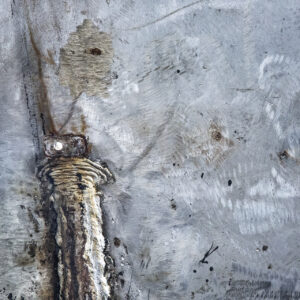
Curtis has used photography to explore entropy as evidenced on hulls and rudders of boats belonging to a fishing fleet at Port Orford, Oregon while in dry dock. His curiosity of fall color reflections on the upper Rogue River’s turbulent flow resulted in a series called Rogue Reflections.
His current work integrates photographs of local geologic formations and USGS 7.5 quadrangle maps of the Rogue Valley and surrounding area. NeoGeo incorporates geology of the Ashland pluton (161 million years ago), the Hornbrook Formation (100 to 65 million years ago), the Payne Cliffs Formation (43 to 34 million years ago) and the Western Volcanics (40 million years ago) all of which were uplifted and tilted by the Klamath terranes about 15 million years ago.
Artist Statement
As a photographer, the act of taking a photograph or a series of photographs is a journey in which a dialogue about environment is opened. A single photograph has multiple interpretations as each raw negative or digital image is processed. With serial photography I meander through interpretive pathways until a thread of content emerges. The chance to discover is what attracts me to photography.
I believe the power of abstraction enables the viewer to access particular associations within themselves. As Minor White stated, ‘One should not only photograph things for what they are, but for what else they are.’